MCT Oil & Cancer: What We Know & What We Don't
May 01, 2025
Medical note: This is educational — not personal medical advice. If you're in active treatment (chemo/radiation/immunotherapy), have unintended weight loss, diabetes, pancreatitis, gallbladder/liver disease, or very high triglycerides, talk with your oncology team and a cancer-trained dietitian before changing fats or trying ketogenic strategies.
MCT oil is everywhere in wellness circles. But when cancer enters the conversation, the usual influencer talking points fall apart fast. The honest answer to "is MCT oil good or bad for cancer?" is: it depends — on tumor biology, your metabolic health, and your treatment context. Here's how to think through it properly.
What MCT Oil Actually Is
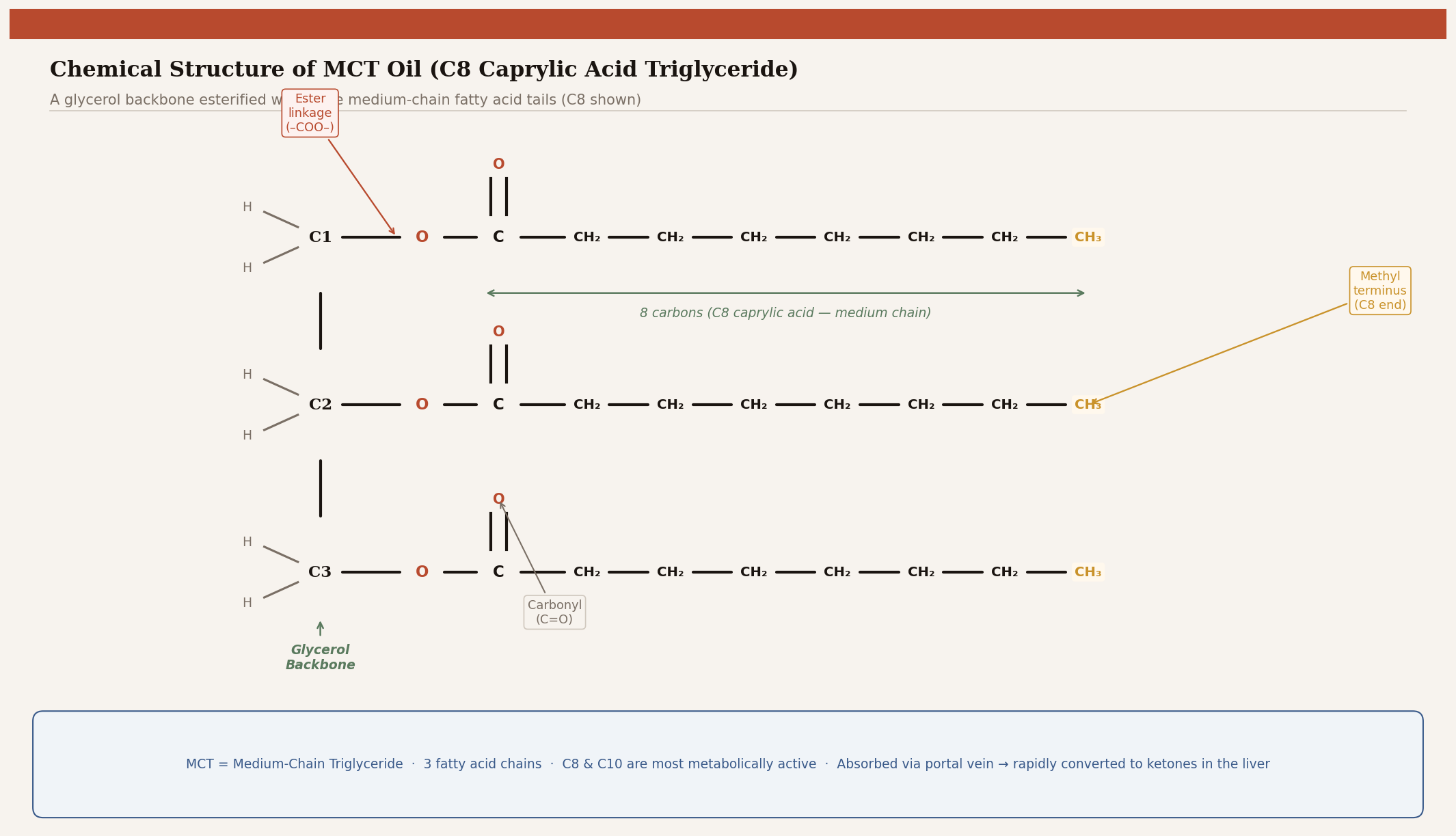
MCT stands for medium-chain triglycerides, typically concentrated forms of C8 (caprylic) and C10 (capric) fats. Unlike the long-chain fats that dominate most diets, MCTs absorb quickly — traveling more directly through the portal vein to the liver — and convert to ketones more readily than almost any other dietary fat. The primary ketone they produce is β-hydroxybutyrate, or BHB.
That's the appeal: MCT oil is a metabolic lever. You can nudge the body toward ketosis without going fully restrictive. Whether that's useful in a cancer context is where things get genuinely complicated.
Why Cancer Enters the MCT Conversation
A central idea in metabolic oncology is that many tumors rely heavily on glucose, and that high insulin and IGF-1 signaling can create a growth-permissive environment. This is why ketogenic diets — and MCTs as a ketogenic aid — get discussed as adjuncts (not replacements) to standard care.
But here's what most MCT content skips: cancer is not one metabolism. Some tumors are strongly glycolytic. Others are metabolically flexible and can run on fatty acids, lactate, glutamine, and yes, ketones. The idea that "starving cancer of glucose" automatically solves anything is an oversimplification that can lead people down the wrong path.
Ketones Are Signals, Not Just Fuel
BHB does more than provide energy. It carries documented signaling roles that matter in cancer biology. It can inhibit certain histone deacetylases (HDACs), altering gene expression tied to oxidative stress resistance. It can also suppress the NLRP3 inflammasome — a key amplifier of chronic inflammation implicated in tumor progression, angiogenesis, and immune suppression.
In that sense, food isn't only calories. It's information that changes redox state, inflammation signaling, gene expression, and the immune landscape. Whether those BHB-driven signals translate into improved cancer outcomes is still being actively investigated, but the mechanisms are real.
The Part Most MCT Advocates Skip
There's credible evidence that some cancers can upregulate ketone-burning enzymes — particularly OXCT1 (SCOT) — and may use ketones to fuel growth or treatment resistance. This doesn't make ketosis universally harmful, but it does mean "ketones are anti-cancer" is dangerously oversimplified.
Clinically, two questions need to stay separate. First: can ketosis lower the host-side growth signals — glucose, insulin, inflammation? Second: can the tumor adapt and burn ketones anyway? Both can be true at the same time, depending on the tumor type. This is why tumor biology, not general enthusiasm for keto, should drive the conversation.
What the Evidence Actually Shows
The evidence exists in tiers, and it matters which tier you're drawing from.
In cell culture studies, some medium-chain fatty acids show anti-proliferative and pro-apoptotic effects in various cancer cell lines. This is hypothesis-generating, not definitive — doses in petri dishes often don't map to real human physiology.
In animal models, ketogenic diets supplemented with MCTs have shown improved anti-tumor effects in some studies, including possible chemotherapy synergy in neuroblastoma models. But mouse tumor microenvironments differ substantially from humans.
In human trials, the evidence is early and mixed. Studies tend to be small, feasibility-focused, and vary widely by cancer type. A Phase 1 safety trial of ketogenic diet plus standard care in newly diagnosed glioblastoma patients reflects the cautious, structured approach being explored. Systematic reviews suggest possible improvements in metabolic markers, body composition, and fatigue — but results are cancer-type-specific and far from settled. Major cancer organizations, including the American Institute for Cancer Research, do not recommend ketogenic diets as standard cancer therapy outside a clinical trial context.
One cautionary note on nutrition headlines: a widely circulated observational analysis claiming ketogenic diets were associated with higher cancer risk was retracted in January 2026. That doesn't prove keto is safe or risky — it shows how messy observational nutrition science can be, and why clinical context should anchor any decision.
When MCT Oil May (or May Not) Make Sense
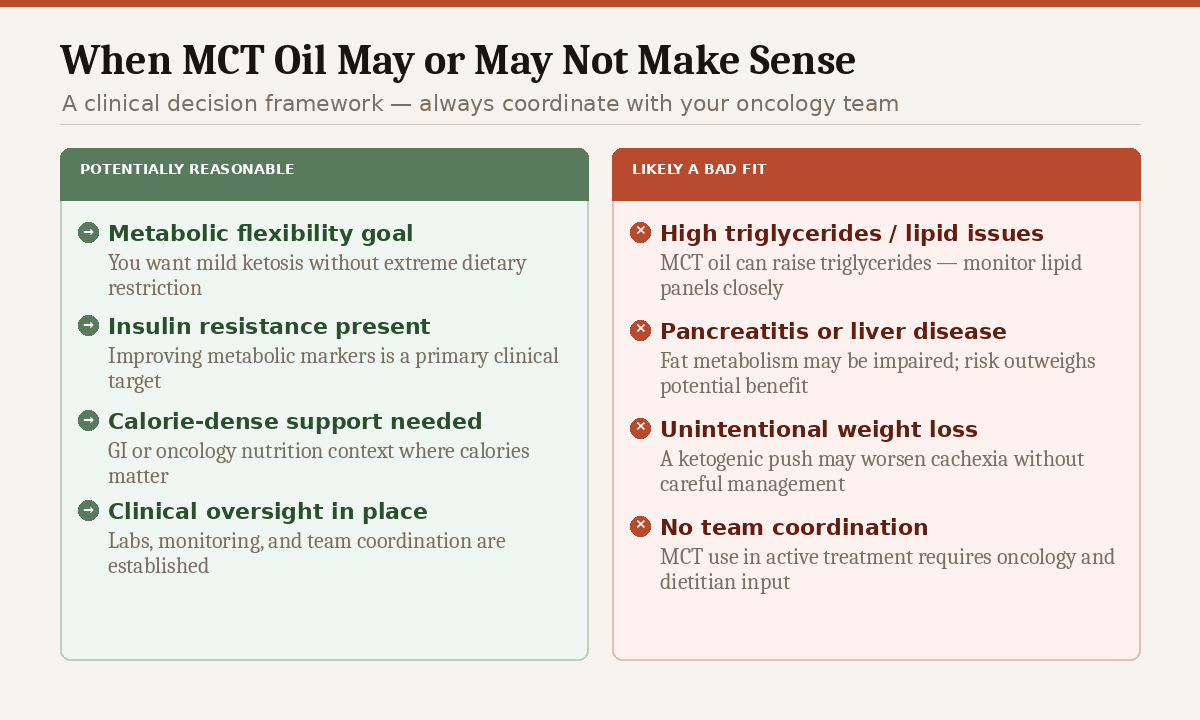
MCT oil may be reasonable to explore with clinical supervision when the goal is metabolic flexibility or mild ketosis without extreme restriction, when there's underlying insulin resistance to address, or when calorie-dense nutritional support is needed.
It's likely a bad fit if you have very high triglycerides or lipid instability (MCT oil can raise triglycerides in some people), a history of pancreatitis or significant liver disease, or unintentional weight loss where a keto push could worsen things.
If You Use It: Start Low, Go Slow
GI side effects — cramping, diarrhea, nausea — are common with rapid dose escalation. A conservative ramp: 1 teaspoon with food for the first few days, then 1 teaspoon twice daily, increasing only if digestion is solid. Always take it with food initially. If your goal is ketones, pairing MCT oil with lower-glycemic meals generally produces a better response than taking it alongside high-sugar foods.
Track what matters: energy levels, stool changes, appetite. With your clinician: fasting glucose, insulin, triglycerides, and weight trend.

The Bigger Picture
MCT oil is a small lever inside a large system. Cancer biology is deeply tied to mitochondrial function, inflammation signaling, circadian timing, stress physiology, tissue oxygenation, and immune competence. If someone wants a genuinely holistic metabolic strategy, higher-leverage priorities include stable blood sugar, adequate protein, consistent sleep and light timing, resistance training where appropriate, anti-inflammatory micronutrient density, and gut health that allows actual absorption.
MCT oil can sit inside that plan. It shouldn't be the plan.
The Bottom Line
MCT oil can raise ketones, and ketones carry real signaling effects that may influence inflammation and cellular stress responses. But cancer metabolism is heterogeneous — some tumors adapt to use ketones — so this is not universally beneficial. Human evidence is early, mixed, and cancer-type-specific. Ketogenic strategies are best explored with clinical oversight and ideally in a research-informed structure. If you try it: start small, track triglycerides and weight, and coordinate with your care team.
Stop Guessing. Start Targeting!
You don’t need a faster metabolism; you need a clearer one. Our Metabolic Quiz identifies the exact "clog" in your system—whether it’s stress, sleep, or substrate utilization—so you can stop the overwhelm and start seeing progress.